Advantages and Disadvantages of Space Frame Structures Advantages
更新時間:2026-07-24 13:43:58?點(diǎn)擊:1736 ? Grid Knowledge
-
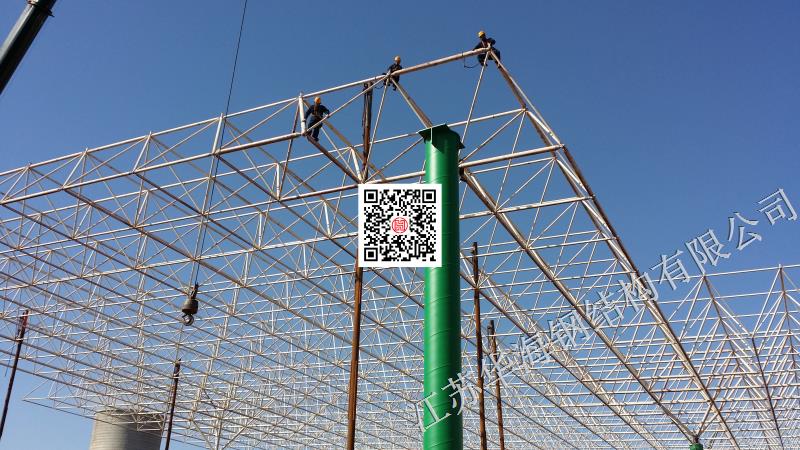
Superior large-span column-free performanceAs a spatial load-bearing system, it disperses loads in multiple directions without intermediate columns. Its economical span ranges from 30 m to 120 m, making it ideal for large open-space buildings such as stadiums, coal storage sheds, exhibition centers and offshore photovoltaic platforms.
-
Light self-weight and steel savingMembers only bear axial tension or compression without bending moments, achieving high material utilization. Compared with concrete roofs and planar steel trusses for the same span, steel consumption can be reduced by 30% to 50%, lowering foundation loads and foundation costs.
-
High overall rigidity and excellent seismic performanceThe 3D grid structure features strong integrity and small deformation. Its resistance to lateral loads, earthquakes and wind loads far outperforms planar trusses, making it suitable for typhoon and earthquake-prone areas.
-
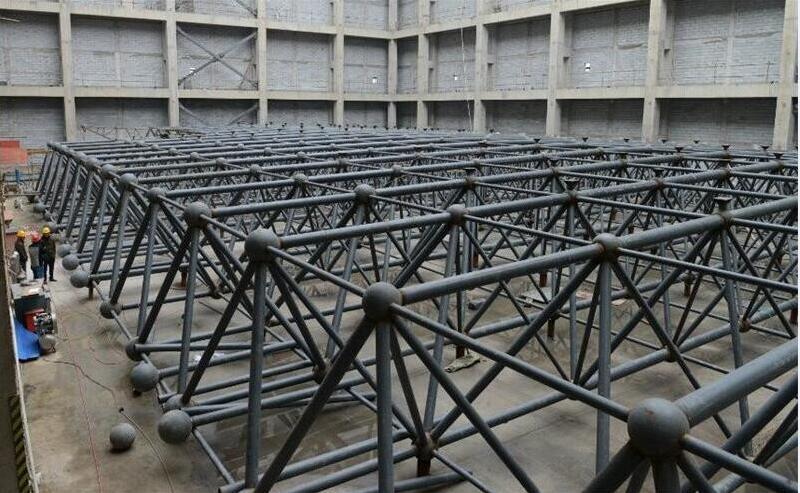
Prefabricated factory production and fast constructionSteel tube members, bolted spheres and welded spheres are all standardized and processed in factories. Bolted sphere space grids only require bolt assembly on site with almost no field welding, shortening the installation period for time-critical projects.
-
Flexible architectural stylingIt can be constructed as flat roofs, as well as arched, spherical, curved and irregular special-shaped roofs to meet diverse architectural appearance requirements.
-
Uniform load distribution and high overload safety marginSingle-point loads are distributed to surrounding multiple members. Damage to a small number of local members will not cause immediate overall collapse, providing higher safety reserves.
Disadvantages
-
Extremely high precision requirements for fabricationStrict tolerance control is required for member lengths, hole angles of spheres and bolt dimensions. Insufficient machining accuracy leads to difficult on-site assembly and abnormal structural stress, imposing high standards on factory equipment and workmanship.
-
Heavy workload for anti-corrosion maintenanceA large number of densely arranged members and numerous gaps at nodes easily accumulate dust and moisture. In humid indoor environments, coastal areas and offshore photovoltaic projects with severe corrosion, rust removal and recoating cycles are short, resulting in high long-term maintenance costs.
-
Complex waterproof detailingDense grids complicate the installation of roof purlins, waterproof rolls and drainage joints. Water accumulation and leakage are prone to occur at grid intersections, raising difficulties in waterproof design and construction.
-
Uneconomical for small-span buildingsFor spans less than 18–20 m, space grids have higher processing costs for nodes and members compared with portal rigid frames and conventional steel beam roof trusses, offering no cost advantages.
-
Dense members restrict pipeline layoutThe underside of the roof is covered with dense steel tubes, leaving limited space for ventilation, fire protection and electrical pipelines, increasing the difficulty of mechanical and electrical construction.
-
Additional drawbacks for special offshore applications (offshore photovoltaic space grids)Long-term exposure to seawater and severe salt spray corrosion requires extra thick anti-corrosion coatings. Crevice corrosion easily occurs at grid gaps, and repeated wave impact causes fatigue damage at nodes, greatly increasing costs for anti-corrosion treatment and structural reinforcement.
Recommended Reading
-
History and Origin of Space Frame Structures
2026-07-21 11:32:35?648 次
-
Does higher zinc content in coatings for space frame anti-corrosion mean better anti-corrosion perfo
2026-06-22 10:32:13?19982 次
-
Construction technology of spherical grid
2021-01-29 14:15:02?36463 次
-
Advantages of bolted ball grid structure
2021-01-29 13:52:26?6147 次


