Differences between Space Grid and Truss
更新時間:2026-07-21 15:45:16?點(diǎn)擊:424 ? Grid Knowledge
Differences between Space Grid and Truss
Load-bearing system (essential difference)
The planar truss bears loads only within a two-dimensional plane and has extremely low out-of-plane stiffness, so lateral bracings are mandatory for stability. As a three-dimensional spatial structure, the space grid transfers loads in multiple directions with inherent spatial rigidity, requiring no extra lateral supports.
Structural composition
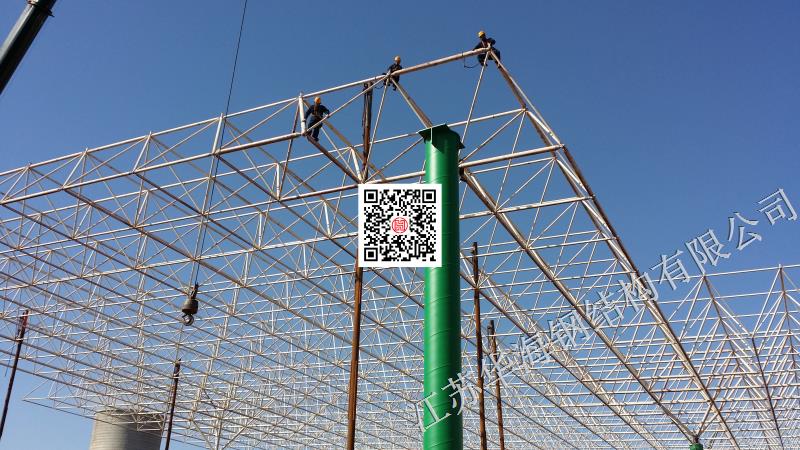
Trusses are composed of planar triangular units, manufactured as whole single frames with few joints. Space grids are assembled from standardized steel tubes and spherical joints based on three-dimensional pyramid units, featuring a large number of components and joints.
Applicable span and interior space
Trusses are suitable for medium and small-span structures; columns are required for large roofs, making a full column-free space hard to achieve. Space grids are ideal for large and super-long-span buildings, enabling full column-free roof coverage and spacious interior space.
Mechanical and seismic performance
Separate truss frames work independently with poor integrity and average seismic and wind resistance. Space grids cooperate integrally with high rigidity, delivering superior performance in earthquake resistance and resistance to uneven settlement.
Shape adaptability and economy
Trusses have limited shape forms and are difficult to form curved roofs. Space grids can be fabricated into flat, spherical and irregular curved surfaces with good daylighting performance. Space grids save more steel for long-span projects, while trusses are more cost-effective for small and medium-span buildings.
Load-bearing system (essential difference)
The planar truss bears loads only within a two-dimensional plane and has extremely low out-of-plane stiffness, so lateral bracings are mandatory for stability. As a three-dimensional spatial structure, the space grid transfers loads in multiple directions with inherent spatial rigidity, requiring no extra lateral supports.
Structural composition
Trusses are composed of planar triangular units, manufactured as whole single frames with few joints. Space grids are assembled from standardized steel tubes and spherical joints based on three-dimensional pyramid units, featuring a large number of components and joints.
Applicable span and interior space
Trusses are suitable for medium and small-span structures; columns are required for large roofs, making a full column-free space hard to achieve. Space grids are ideal for large and super-long-span buildings, enabling full column-free roof coverage and spacious interior space.
Mechanical and seismic performance
Separate truss frames work independently with poor integrity and average seismic and wind resistance. Space grids cooperate integrally with high rigidity, delivering superior performance in earthquake resistance and resistance to uneven settlement.
Shape adaptability and economy
Trusses have limited shape forms and are difficult to form curved roofs. Space grids can be fabricated into flat, spherical and irregular curved surfaces with good daylighting performance. Space grids save more steel for long-span projects, while trusses are more cost-effective for small and medium-span buildings.
Recommended Reading
-
History and Origin of Space Frame Structures
2026-07-21 11:32:35?648 次
-
Does higher zinc content in coatings for space frame anti-corrosion mean better anti-corrosion perfo
2026-06-22 10:32:13?19982 次
-
Construction technology of spherical grid
2021-01-29 14:15:02?36463 次
-
Advantages of bolted ball grid structure
2021-01-29 13:52:26?6147 次


